


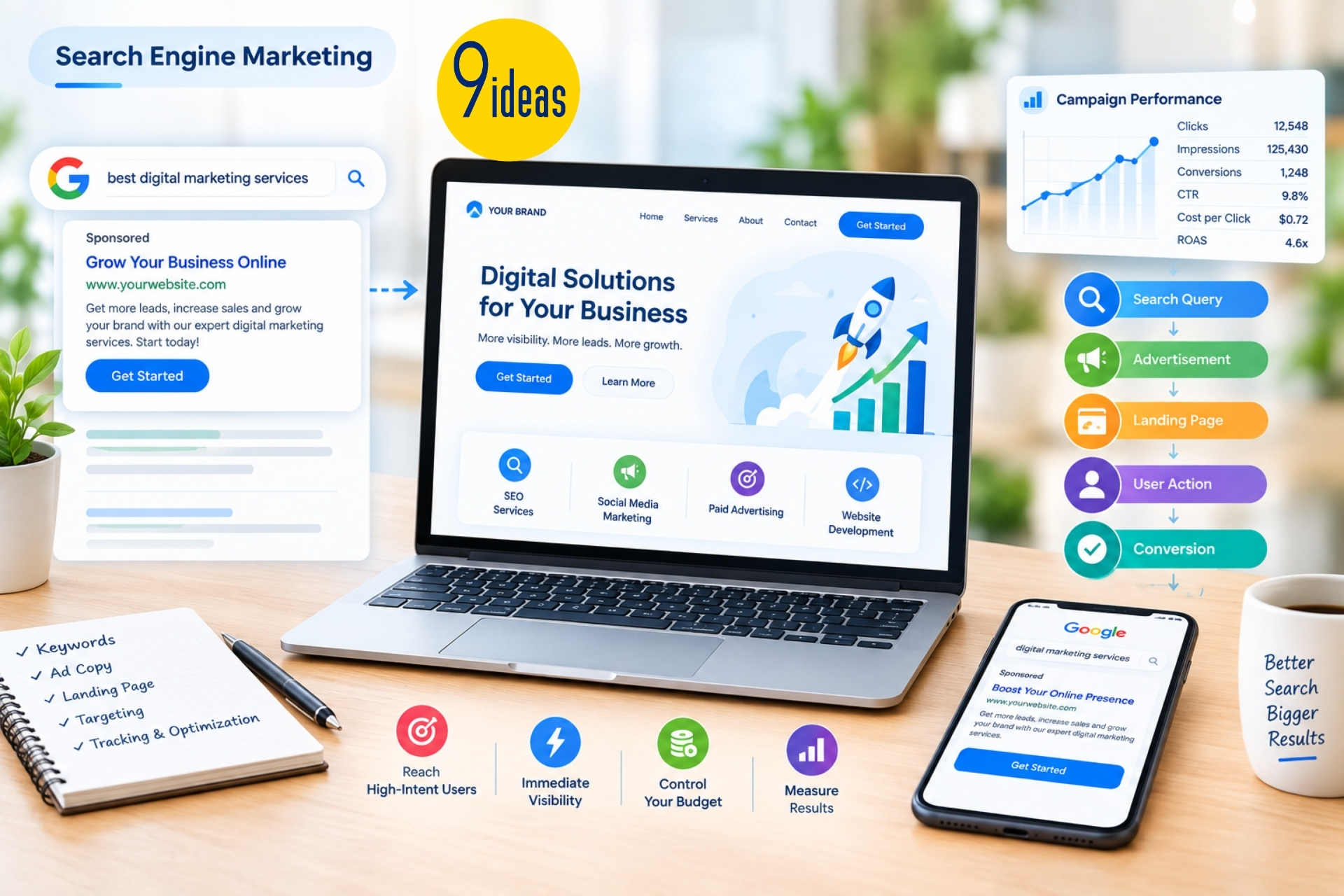
When people search for products, services or solutions online, businesses have an opportunity to reach them at the moment they are actively looking for information. Search Engine Marketing (SEM) helps businesses use paid search advertising to connect with these potential customers.
A well-planned Search Engine Marketing Strategy combines keyword research, audience targeting, compelling advertisements, landing pages and performance measurement to create more effective paid search campaigns.
What is Search Engine Marketing?
Search Engine Marketing refers to marketing activities that use search engines to increase visibility and attract users.
In paid search, businesses create advertisements that can appear for relevant search queries through advertising platforms such as Google Ads.
SEM campaigns can focus on objectives including:
- Website traffic
- Lead generation
- Product sales
- Brand visibility
- Conversions
Why Search Engine Marketing Matters
Reach High-Intent Users
Search advertising can reach users who are actively searching for products, services or information.
For example, a person searching for a specific service may already be evaluating available options.
Generate Immediate Visibility
Unlike organic strategies that may take time to build visibility, paid search campaigns can provide advertising exposure once campaigns are approved and running.
Control Advertising Budgets
Advertisers can establish campaign budgets and monitor spending based on campaign performance.
Measure Campaign Results
SEM provides access to detailed performance data, allowing businesses to evaluate:
- Clicks
- Impressions
- Conversions
- Cost per click
- Cost per conversion
- Return on ad spend
Key Elements of an SEM Strategy
Keyword Research
Businesses should identify relevant search terms based on customer needs and search intent.
Keywords can include:
- Informational searches
- Commercial searches
- Transactional searches
- Local searches
Ad Copy
Advertisements should clearly communicate the product or service and provide a relevant reason for users to take action.
Landing Pages
Users should be directed to landing pages that closely match the advertisement and search intent.
A strong landing page can include:
- Clear headline
- Relevant information
- Strong call to action
- Simple enquiry form
- Mobile-friendly design
Audience and Location Targeting
Businesses can use available targeting options to focus campaigns on relevant audiences and service areas.
SEM and PPC
PPC Advertising is an important component of paid search marketing.
A typical process is:
Search Query → Advertisement → Landing Page → User Action → Conversion
The campaign can then be analyzed and optimized based on performance data.
SEM vs Organic Search
Paid search and organic search serve different purposes.
SEM/Paid Search:
- Paid visibility
- Campaign-based
- Budget controlled
- Immediate advertising exposure
SEO:
- Organic visibility
- Content and technical optimization
- Long-term strategy
- No payment for individual organic clicks
Businesses can use both approaches as part of an integrated search marketing strategy.
Common SEM Mistakes
Businesses should avoid:
- Targeting irrelevant keywords
- Ignoring negative keywords
- Using generic advertisements
- Sending traffic to unrelated pages
- Failing to track conversions
- Focusing only on clicks
Conclusion
A structured Search Engine Marketing Strategy helps businesses reach users through targeted paid search campaigns.
By combining relevant keywords, effective advertisements, optimized landing pages and accurate performance tracking, businesses can create more measurable and efficient SEM and PPC campaigns.
FAQs
1. What is Search Engine Marketing?
Search Engine Marketing uses search engines to promote businesses through paid search advertising and related marketing activities.
2. Is SEM the same as PPC?
PPC is a major component of paid search marketing, while SEM is a broader term used for search engine marketing.
3. Why is keyword research important in SEM?
Keyword research helps businesses identify relevant searches and align advertisements with user intent.
4. What metrics should SEM campaigns track?
Clicks, impressions, CTR, conversions, cost per click, cost per conversion and ROAS can be useful depending on campaign objectives.
5. Can SEM and SEO work together?
Yes. Paid search can provide immediate advertising visibility while SEO focuses on organic search visibility over the longer term.
