


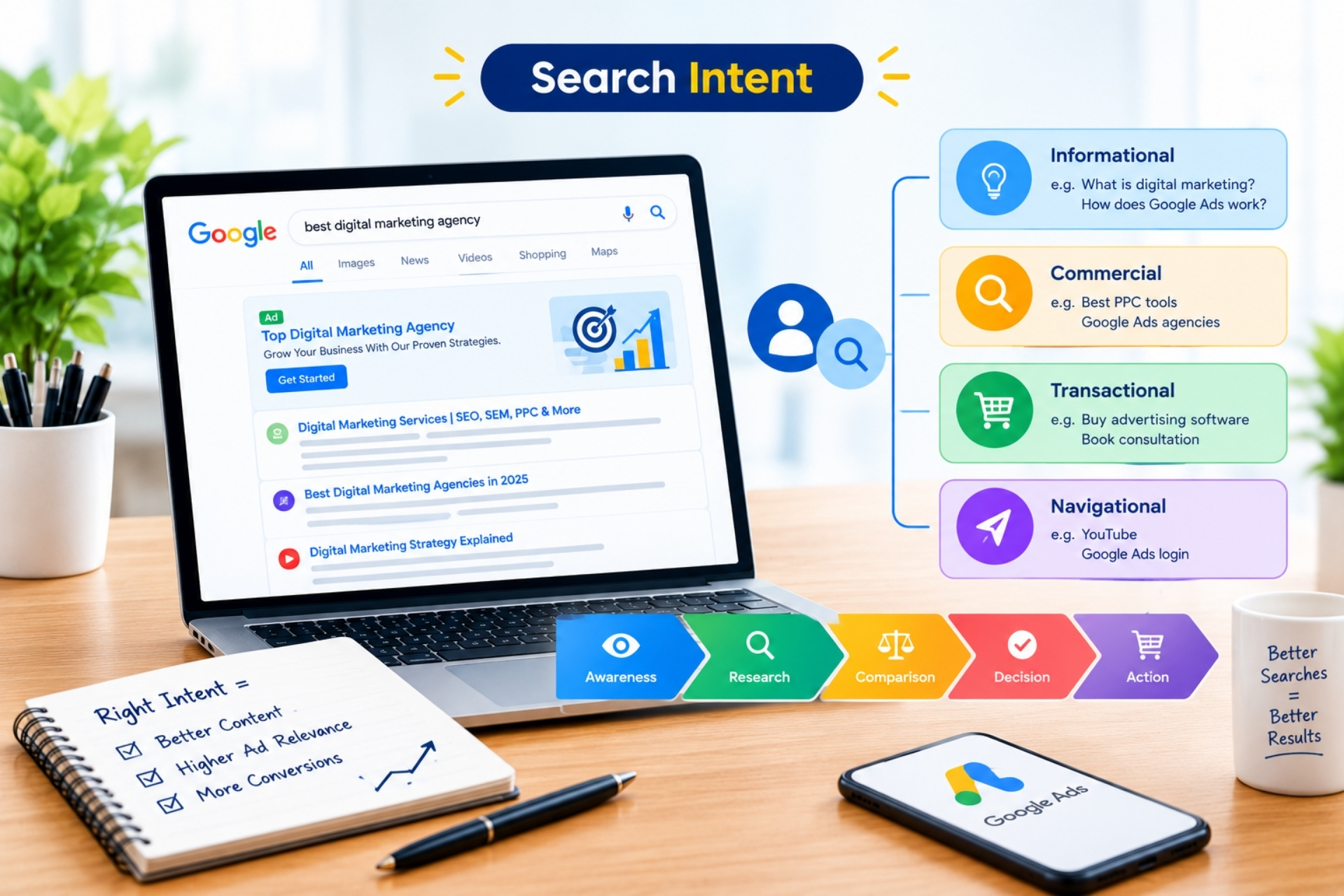
People use search engines for different reasons. Some want to learn something, others compare products, while some are ready to make a purchase. Understanding Search Intent helps digital marketers create content, advertisements and landing pages that better match what users are looking for.
Search intent is therefore relevant not only to SEO but also to SEM, PPC campaigns, Google Ads and broader digital marketing strategies.
What is Search Intent?
Search intent refers to the underlying purpose behind a user’s search query.
For example:
“What is PPC advertising?”
suggests an informational purpose.
While:
“Buy running shoes online”
indicates a stronger transactional purpose.
Understanding the difference helps marketers select appropriate content and campaign strategies.
Main Types of Search Intent
Informational Intent
Users are looking for information or answers.
Examples:
- What is digital marketing?
- How does Google Ads work?
- What is social media marketing?
Suitable content may include:
- Blog articles
- Guides
- Tutorials
- Educational videos
Commercial Intent
Users are researching products, services or solutions before making a decision.
Examples:
- Best PPC tools
- Google Ads agencies
- Email marketing software comparison
Useful content can include:
- Comparisons
- Reviews
- Case studies
- Product guides
Transactional Intent
Users are ready to complete an action.
Examples:
- Buy advertising software
- Book digital marketing consultation
- Sign up for PPC service
Landing pages and conversion-focused pages may be appropriate for these searches.
Navigational Intent
Users are looking for a specific website, brand or online destination.
Examples:
- YouTube
- Google Ads login
- Facebook Business
Why Search Intent Matters
Better Content Relevance
Understanding intent helps marketers create content that addresses the user’s actual need.
Better PPC Campaigns
Advertisers can align keywords and advertisements with the purpose behind a search.
Better Landing Pages
A landing page should provide information that matches what the user expected after clicking an advertisement.
Search Intent and Google Ads
Search intent can help advertisers structure PPC campaigns.
For example:
Commercial Search → Comparison Ad → Relevant Landing Page
Transactional Search → Product Ad → Conversion Page
The closer the alignment between query, advertisement and landing page, the more consistent the user experience can be.
Search Intent and SEO
SEO content can also be organized around user intent.
Instead of creating content solely around keywords, marketers can ask:
- What does the user want?
- What information are they seeking?
- What action might they take next?
This creates a more audience-focused content strategy.
Search Intent and Customer Journey
Search intent can change as customers move through the buying journey:
Awareness → Research → Comparison → Decision → Action
Understanding these stages helps marketers develop appropriate messages for different audiences.
Common Search Intent Mistakes
Businesses should avoid:
- Targeting keywords without understanding intent
- Sending informational searches to aggressive sales pages
- Using generic landing pages
- Ignoring commercial and transactional searches
- Creating content that does not answer the user’s question
Conclusion
Search Intent provides valuable insight into what users are trying to accomplish through search engines.
By aligning content, advertisements, keywords and landing pages with user intent, businesses can create more relevant SEO, SEM, Google Ads and PPC campaigns and provide a better customer experience.
FAQs
1. What is search intent?
Search intent is the purpose or reason behind a user’s search query.
2. What are the main types of search intent?
Informational, commercial, transactional and navigational intent are commonly used categories.
3. Why is search intent important for PPC?
It helps advertisers align keywords, advertisements and landing pages with what users are looking for.
4. Does search intent matter for SEO?
Yes. Understanding user intent helps marketers create content that addresses the needs behind search queries.
5. Can search intent change during the customer journey?
Yes. A user may begin with an informational search and later move toward commercial or transactional searches.
